
About This Project
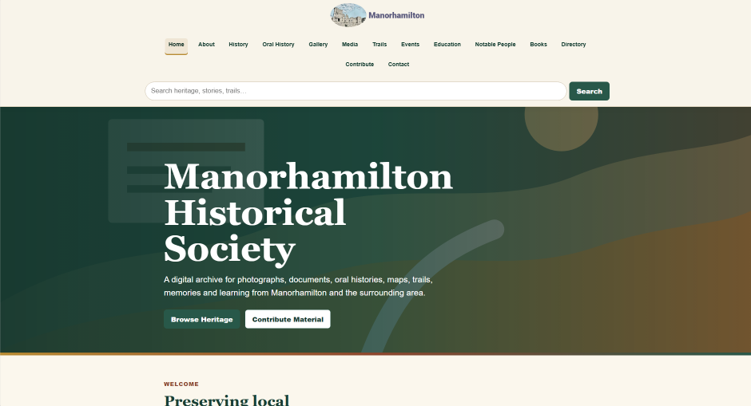
Manorhamilton Historical Society is a community-based heritage organisation dedicated to promoting interest in the history, heritage, and archaeology of Manorhamilton and the surrounding North Leitrim area. The Society plays an important role in preserving, interpreting, and sharing the town’s rich local history, including its nearly 400-year heritage since the founding of Manorhamilton by Sir Frederick Hamilton in the 1630s. The Society has a strong record of community heritage activity, including lectures, exhibitions, guided outings, commemorative events, and local historical projects. Previous initiatives have included commemorations linked to North Leitrim soldiers lost in World War I, the legacy of Seán Mac Diarmada, and the Sligo, Leitrim and Northern Counties Railway. The project was developed through the STRIDE Programme following a Design Thinking Workshop and an agreed Project Summary Document. The organisation identified that a large amount of valuable historical material was dispersed across private homes, filing cabinets, local collections, and informal repositories. Much of this material was not digitally organised or publicly accessible, creating a risk that important local history could be lost over time. The initial challenge centred on the Society’s limited access to IT skills and the difficulty of gathering, preserving, organising, and sharing dispersed heritage material in a way that was accessible to the public. The agreed solution focused on a realistic, low-cost, scalable digital heritage platform that could act as a central online access point for Manorhamilton’s historical material, while supporting future physical-digital initiatives such as QR codes, trails, exhibitions, and community engagement.
Design Thinking Workshops
20 participants attended the Design Thinking Workshop on 22 January 2026 at the Beepark Community Centre in Manorhamilton. Participants were divided into three groups representing users and were asked to remain open to the process, draw on lived experience, and share what they had heard, seen, thought, felt, said, and done in relation to the challenge.
Participants were provided with an overview of the STRIDE Programme and an introduction to the Design Thinking process. The workshop used empathy mapping, journey mapping, challenge definition, ideation, prioritisation, prototyping, and testing.
The group collectively agreed the following How Might We challenge statement:
“How Might We develop a digital solution that collates dispersed historical records for public access to ensure the 400-year heritage of Manorhamilton, including physical materials, is protected and preserved?”
The workshop showed strong agreement that the challenge was not simply about digitising material. Participants emphasised the need to tell, organise, curate, and preserve Manorhamilton’s story in a meaningful and accessible way. Key themes included public access, searchable content, preservation of fragile materials, GDPR and permissions, physical archive stewardship, local storytelling, intergenerational collaboration, and long-term sustainability.
Following the workshop, the agreed project scope was refined into a realistic digital solution based on available time, limited budget, organisational capacity, volunteer skills, and STRIDE Programme feasibility.
Deliverables
STRIDE deliverables included:
· A central website or digital heritage platform for Manorhamilton Historical Society
· A low-cost, user-friendly, publicly accessible online portal
· A clear structure for organising local heritage material
· Searchable and navigable content where feasible
· Support for photographs, scanned documents, audio, video, oral histories, genealogy, folklore, research outputs, and community history
· Website sections including Home, About the Society, History and Heritage, Stories and Oral Histories, Gallery, Videos and Audio, Maps and Trails, Events, Contact, Donate or Contribute Content, and Education or Youth content
· A community contribution pathway so members of the public can offer information or materials for review
· Improved visibility of Society activity, events, talks, exhibitions, and local heritage work
· Support for future QR codes, heritage trails, exhibitions, signage, and physical-digital engagement
· A manageable administration process for non-technical users
· A scalable platform that can grow over time as more material becomes available
· Digital handover guidance so Society members can manage and update the website independently
Results & Impact
The project provides Manorhamilton Historical Society with a practical and sustainable digital foundation for preserving and sharing the town’s heritage.
The main agreed outcome is a central website-based digital heritage platform that allows historical material to be organised, accessed, updated, and expanded over time. The platform responds directly to the Society’s need for a single point of access where dispersed heritage content can be brought together and made more visible to the public.
The website will support core content areas such as local history, oral histories, photographs, documents, videos, audio, genealogy, folklore, maps, trails, events, and community contributions. It will also provide a clearer structure for public engagement, allowing users to browse, search, learn, contribute, and connect with the Society.
The project recognises that not all heritage preservation needs can be solved within the STRIDE Programme. Full specialist digitisation of every archive item, long-term preservation of fragile physical materials, physical artefact storage, advanced virtual or augmented reality, and complex paid platforms were identified as out of scope.
Instead, the project prioritises a proportionate digital solution: a manageable WordPress platform that can be updated by non-technical administrators, expanded over time, and used as a foundation for future funding, partnership, digitisation, exhibitions, QR trails, and community heritage initiatives.
Community Impact
The Manorhamilton Historical Society project demonstrates how digital social innovation can support a community heritage organisation through practical, low-cost, and sustainable technology.
The redesigned digital platform will improve public access to Manorhamilton’s history and heritage by creating a central place where local stories, photographs, documents, oral histories, events, and trails can be shared. This is particularly important because much of the Society’s material has historically been held in private homes, filing cabinets, local collections, and informal repositories, limiting wider access and increasing the risk of loss.
The project will benefit local residents, older people, young people, schools, visitors, tourists, diaspora communities, researchers, and community groups. It will also help the Society communicate its work more clearly, promote events more effectively, and encourage wider community contribution.
A key community benefit is the opportunity for intergenerational collaboration. Workshop participants identified the potential for young people, including Transition Year students, to support recording, digitisation, QR trails, and digital skills development while learning from older residents’ historical knowledge.
The platform also supports future physical-digital engagement. QR codes, maps, signage, exhibitions, walking trails, and public displays can be linked back to online content, helping Manorhamilton become more visible as a recognised historical town.
The project prioritises realistic digital transformation. It does not attempt to digitise or preserve every item immediately. Instead, it creates a flexible foundation that respects the Society’s limited budget, limited IT capacity, volunteer-led structure, and long-term stewardship responsibilities.